
Plastic Injection Molding
Why PEEK Is the Future of High-Speed Cooling Fans for Electronics? Advanced Injection Molding Soluti
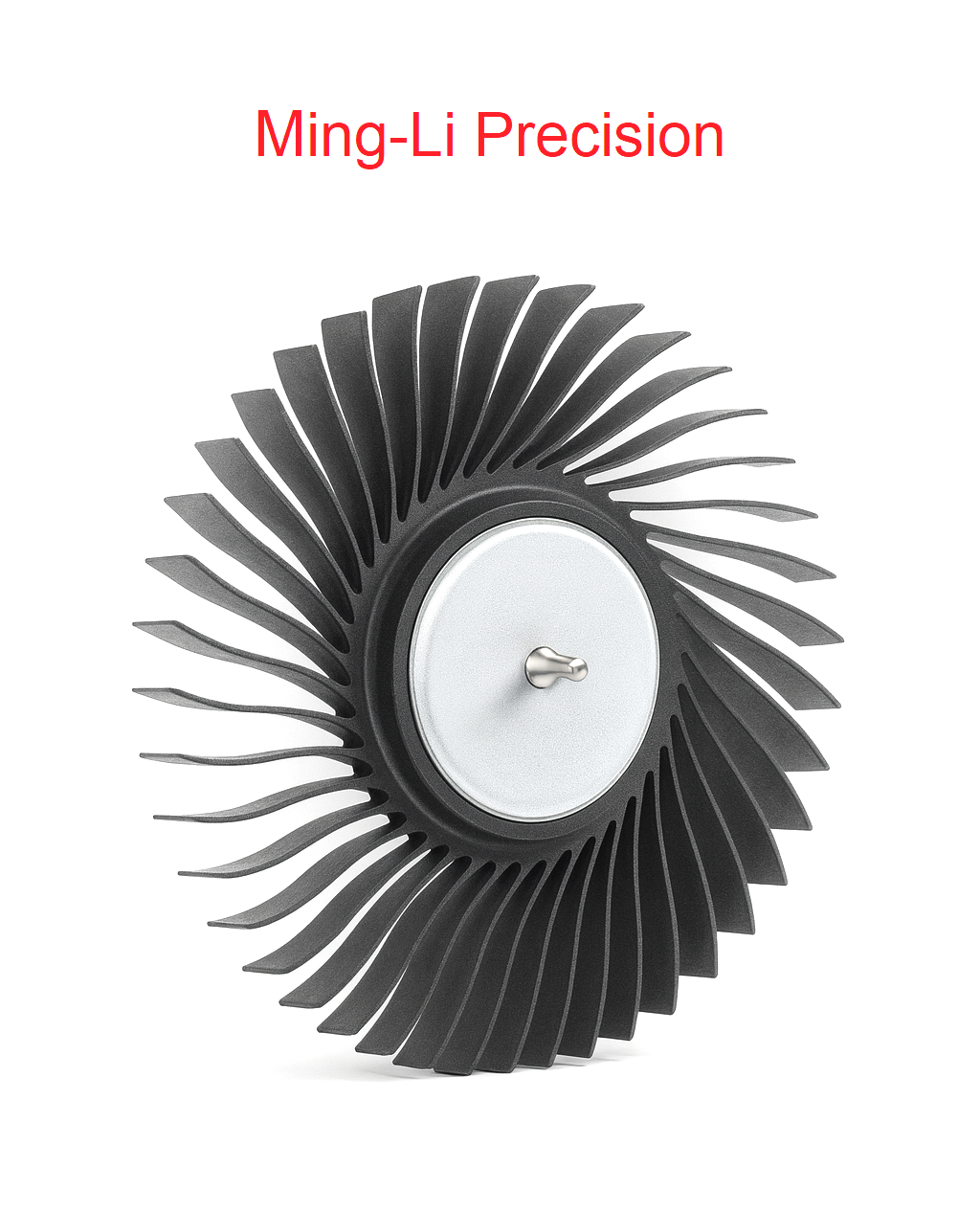
Introduction – Cooling Is No Longer Just an Accessory, It Is Engineering Survival
Modern electronic devices are undergoing an unprecedented transformation. CPUs and GPUs exceed 150W in notebook form factors, AI accelerators for data centers run at 350W–700W, and 5G base stations and automotive inverters must sustain extreme thermal loads. Thermal failure is now the number one cause of electronic degradation and early system failure.
Cooling fans—particularly high-speed micro impellers—have evolved from simple airflow components to critical engineered parts that directly determine device performance, acoustic quality, and product lifespan.
But there is a serious engineering problem:
Devices are getting thinner
Power consumption is getting higher
Airflow demand is increasing
Acoustic noise limits are stricter
Size tolerance remains tight
Traditional fan materials simply can't keep up—which is why PEEK (Polyether Ether Ketone) has become the material of choice for next-generation cooling impellers.
1. Why Traditional Fan Materials Fail at High Speed
Most existing consumer and industrial cooling fans are still made with PPS, PA66, or PC/ABS. These materials are cost-effective but were never designed for sustained high RPM (15,000–35,000 RPM) or thermal cycling near CPU heat zones.
| Failure Mechanism | What Happens in Real Use | Result |
|---|---|---|
| Thermal softening (PPS/PA66) | Loss of stiffness above 120°C | Blades deform → airflow drops |
| Creep under load | Gradual bending of blade roots | Long-term performance loss |
| Fatigue cracking | Blade root fractures over time | Vibration → catastrophic failure |
| Warp and shrinkage | Poor dimensional control | Imbalance + noise |
| Humidity absorption (PA66) | Dimensional expansion | Blade interference + noise |
These problems lead to unstable airflow, shorter fan life, mechanical vibration, noise, and in extreme cases, blade detachment—a safety hazard in electronics and automotive applications.
2. Why PEEK Solves These Critical Fan Engineering Challenges
PEEK offers the highest mechanical stability among commercially moldable polymers.
| Property | PEEK Advantage |
|---|---|
| Heat resistance | 260°C continuous, 300°C intermittent |
| Modulus | 3.6 GPa unfilled, 18–22 GPa (CF grades) |
| Fatigue strength | Superior performance under cyclic loading |
| Density | Lightweight but rigid |
| Chemical resistance | Impervious to coolants, flux, oils |
| Dimensional stability | Retains geometry over lifetime |
PEEK = High Speed + High Temperature + Precision Stability
Maintains blade stiffness at high RPM
Prevents flutter and air turbulence
Maintains tip clearance for high efficiency
Supports ultra-thin fan design
Enables quieter fans with more airflow
PEEK isn’t just an upgrade—it’s a new design freedom for thermal module engineers.
3. Why PEEK Enables Quiet and Powerful High-RPM Fans
In a high-speed impeller, dynamic balance is everything. Any mass asymmetry causes vibration and tonal noise. PEEK offers:
-
Higher natural frequency → avoids blade resonance
-
Lower blade deformation → airflow curve stays stable
-
Better runout control → balanced rotation for low noise
-
Thinner blade profiles → more blades = smoother airflow
PEEK improves both cooling efficiency and acoustic performance
4. PEEK Enables Innovation in Thermal Module Design
PEEK impellers are used in:
| Application | Performance Requirement |
|---|---|
| Ultrabook cooling fans | 0.2–0.35mm blades, ultra-quiet |
| Gaming notebook fans | high airflow with thin design |
| AI server blowers | 24/7 full-speed durability |
| 5G telecom cooling | high temperature outdoor use |
| Automotive ECU & inverter cooling | long-term thermal stability |
| Industrial servo drives | high-reliability operation |
5. Engineering Advantages of PEEK Fan Design
-
Blade pitch accuracy improves pressure curve
-
Thin-wall molding improves airflow uniformity
-
High stiffness enables higher RPM limits
-
Superior thermal endurance keeps geometry intact
-
High fatigue resistance → long lifespan
6. Why PEEK Is Hard to Mold (and Why Most Companies Fail)
PEEK molding is extremely technical:
| Challenge | Problem |
|---|---|
| 400°C melt temp | Standard hot runner dies |
| Warpage risk | Crystallization causes distortion |
| Blade breakage | Thin walls need ultra-precise filling |
| Tool wear | Requires hardened mold steel |
| Short shot defects | Hard to fill micro blades |
| Balance inconsistency | Shrinkage causes asymmetry |
That’s why very few suppliers can mass-produce PEEK cooling impellers with the tolerance and blade symmetry required for demanding electronics.
7. Ming-Li Precision – PEEK Fan Production Expert
Ming-Li Precision is one of the few high-performance molding companies in Asia capable of mass manufacturing ultra-precise PEEK fans.
Capability Highlights
| Capability | Details |
|---|---|
| Ultra-precision moldmaking | ±1µm YASDA CNC milling |
| High-temperature molding | Up to 420°C |
| Thin-wall molding | 0.18–0.30 mm |
| Dynamic balancing support | ISO balance class |
| Dimensional verification | ZEISS METROTOM 6 CT |
| Quality system | IATF 16949 certified |
| Aerospace & EV-grade polymers | PEEK, PPSU, LCP |
| Moldflow simulation | Warpage + Crystallization |
We control balance, blade uniformity, and molding flow to guarantee stable high-speed performance.
8. PEEK Fan Manufacturing Workflow at Ming-Li
-
DFM + Moldflow Simulation
-
Ultra-precision tooling
-
Hot runner PEEK molding
-
Cooling and crystallinity control
-
CMM + CT measurement
-
Dynamic balancing
-
Performance validation
-
Mass production
9. Case Study Example
AI Server Fan – Intel/AMD GPU Cooling
-
RPM: 26,000
-
Blade thickness: 0.25 mm
-
Result: +18% airflow vs PPS, -6 dBA noise
EV Inverter Cooling Fan
-
Environment: 130°C continuous
-
Result: zero deformation after 2,000 hours thermal cycling
Ultrabook Micro Blower
-
Fan height: 3.2 mm
-
Result: Passed 10,000-hour endurance test
Conclusion – Why PEEK Is the Future of Electronic Cooling
PEEK allows thermal engineers to push the limits of airflow, speed, size, and silence.
It delivers the highest performance per gram of any moldable material.
High-speed capability
Dimensional stability
Acoustic control
Long service life
Mass production ready
That is why PEEK is not just an alternative—it is the future of cooling fans.
Work With Ming-Li Precision
If your cooling system requires high-speed, high-efficiency, precision-engineered PEEK fan impellers, Ming-Li Precision is ready to support:
Engineering collaboration
Mold design & simulation
Ultra-precision molding
CT measurement & balancing
Prototype to mass production
Contact today for RFQ
karl@mingli-molds.com.tw